Kinder Enrolment 2027: When Should You Enrol Your Child?
September 21, 2026


The first five years shape more learning than any stretch of life that follows. In that time a child learns to talk, share, solve problems and trust the adults around them. So the benefits of early childhood education reach well beyond finger painting and story time. For families across Melbourne, the right early learning centre gives a child a warm, capable start. Here’s what quality early education really does for children aged 0 to 5, and how to recognise it on a tour.
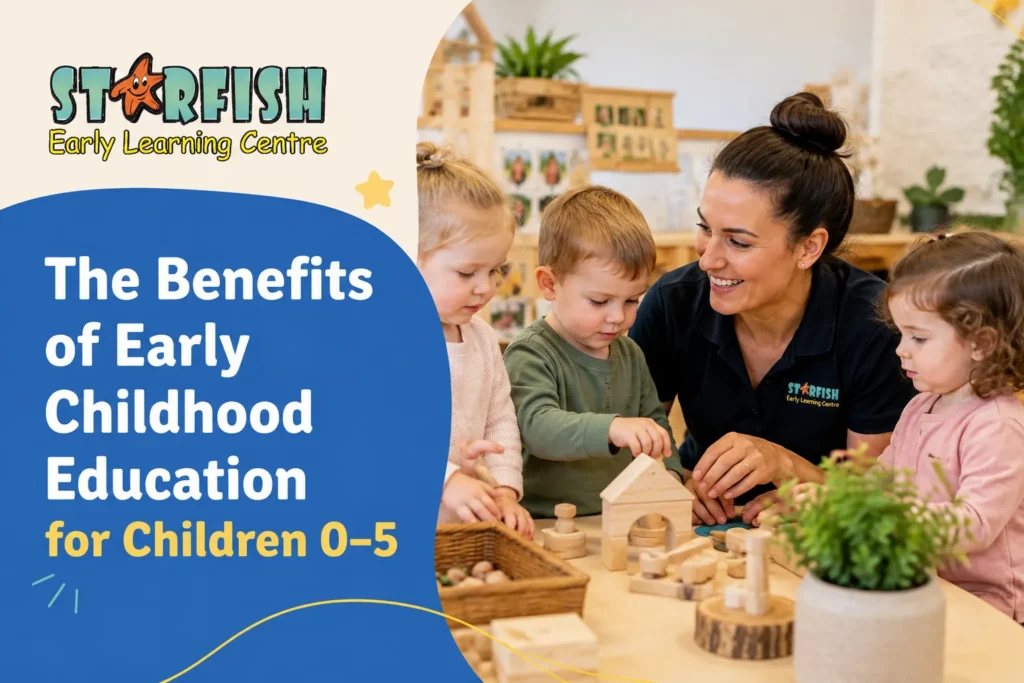
Early childhood education helps children build social and emotional skills, language, curiosity and confidence in the years before school. Guided by qualified educators and a framework like the EYLF, children learn through play, form secure relationships, and pick up the everyday habits that make starting school feel familiar rather than strange.
A child’s brain grows faster from birth to age five than at any later point. Everyday moments, being spoken to, read with, comforted and encouraged, build the connections behind language and feeling. The Australian Early Development Census measures how children are tracking as they start school, across areas like language, social skills and physical wellbeing. Good early learning supports every one of them. It never rushes a child, and it leaves room to explore.
Waiting, sharing and naming a feeling is hard work for a small child. Educators coach these social skills in early childhood through real moments: a turn on the swing, a squabble over blocks, a friend who needs a hug. Bit by bit, children learn to read others and steady themselves. Those quiet wins carry into friendships and, later, the classroom.
Children absorb words, rhythm and meaning long before they read. Songs, stories, questions and play grow vocabulary and early maths, no worksheets needed. At Starfish, counting seeds in the kitchen garden or naming what’s growing teaches more than any flashcard. Language sits inside real experiences, so it sticks.
Ask a three-year-old why the sky is blue and you’ll meet a scientist at work. Real materials to test, build and wonder about keep that spark alive. Our educators plan experiences that stretch thinking, which you can see in how we nurture early childhood STEM. Curious children ask better questions, and that habit lasts.
Small wins add up fast. Pouring their own water, hanging up a bag, trying a new vegetable at lunch, each one builds belief. Fresh, chef-prepared meals, active outdoor play and steady daily routines help children feel settled and capable. A confident child is ready to have a go at almost anything.
Play-based learning is how young children make sense of the world. Through sensory play, construction and imaginative games, they test ideas, practise language and work out how things fit together. It looks like fun, and it is. Underneath, children are building the thinking skills that formal schooling draws on later. Play isn’t a break from learning at this age. It is the learning.
For the youngest children, a 0 to 3 programme follows each family’s home routine, with sleep, feeds and play shaped around the individual child. As children grow, the funded kindergarten program lifts things up a gear.
In Victoria, families may access 3 year old kindergarten and a four-year-old kinder year, and at Starfish this runs inside long day care. That means kinder hours and full-day care in one place, led by Bachelor-qualified Early Childhood Teachers and shaped by the Early Years Learning Framework. Among the benefits of kindergarten here: no worksheets, plenty of wonder, and a steady path toward school.
Look past the brochure and watch how the place feels. A clear philosophy matters, so ask how the centre puts it into practice each day. Starfish draws on a Reggio-inspired philosophy, where the family is a child’s first teacher and the environment acts as the third.
Check that the programme is assessed under the National Quality Framework, that spaces are purpose-built for real play, and that meals are fresh and made on site. Above all, meet the people. You can meet our educators and see who will greet your child each morning.
There’s no single right answer. Some families start at six weeks when returning to work, others wait until the toddler years. What counts is a calm settling-in period and educators who follow your child’s cues. Starfish welcomes children from six weeks, with orientation play sessions before the first full day.
For most families, the Child Care Subsidy reduces the gap fee. Your out-of-pocket cost depends on your family’s entitlement, which Services Australia works out, not the centre. The clearest way to see real numbers is a tour, where we can talk it through for your days and hours.
They overlap more than the labels suggest. Long day care and early learning describe the same full-day service for children from six weeks to five years. Funded kindergarten is a specific programme in the years before school, and at Starfish it sits inside that longer day rather than in a separate building.
Yes. Time spent building language, friendships and independence supports school readiness far more than early drilling. Children who feel secure and curious tend to walk into their first classroom ready to try, ask and belong.
The easiest way to judge a centre is to stand in it. Book a tour at one of our six Melbourne centres, meet the Centre Director, walk the rooms, and ask anything. Call 1300 168 881 or enquire online to find a time that suits your family.
You can explore your nearest Starfish centre here:
Or, if you’re ready to speak with the team, book a Starfish ELC tour.
We’ll help you understand what starting care can look like for your child, one gentle step at a time.