Child Safety in Childcare: How Starfish ELC Builds It Into Every Day
October 22, 2026


Working out how to choose a childcare centre is one of the harder calls you’ll make in your child’s first five years. Every website uses the same words. Warm. Safe. Play-based. With six tabs open at the kitchen table, they blur into one.
The differences show up in person, usually within twenty minutes of walking through the door.
Here’s what to look at, and the order we’d look at it in.
Watch how educators speak to children, ask how settling in works, and look closely at the outdoor space. Find out who cooks the food and how you’ll hear about your child’s day. Look up the centre’s National Quality Standard rating yourself. Then work out your real weekly cost after subsidy, not the advertised daily rate.
Photos are styled. A room at 10am on a Tuesday is not.
Ask to visit during a busy stretch of the day, not the quiet hour after lunch. You want to see what happens when twelve toddlers all want the same thing at once. Noise is fine. Chaos with no adult inside it is not.
Every Starfish tour is run by the Centre Director, which matters more than it sounds. That’s the person you’ll hand your child to on a wet Monday, and the person you’ll call when something’s wrong.
New furniture is easy to buy. Long educator relationships take years to build.
Look at what happens when a child gets upset. A good educator crouches to the child’s level, uses their name, and knows what they were doing thirty seconds ago. That’s the whole job, and you can see it in one minute.
Two questions worth asking: how long have the educators in this room been here, and who leads the kindergarten programme? Funded kindergarten rooms need a bachelor-qualified Early Childhood Teacher, not a Cert III alone.
“We have an orientation process” tells you nothing. Ask for the specifics.
At Starfish, every child gets two one-hour orientation play sessions before their first full day, and more if they need them. Educators follow the child’s cue during those sessions, because some children want a cuddle, some want an adult nearby, and some want to be left alone with the blocks.
Ask directly: what happens on my child’s first morning if they won’t let go of my leg? The answer tells you how the centre thinks about crying. It should be treated as communication, not a behaviour to shut down.
Reggio Emilia practice treats the environment as a third teacher, alongside families and educators. It’s a useful lens even if the centre you’re touring has never heard of it.
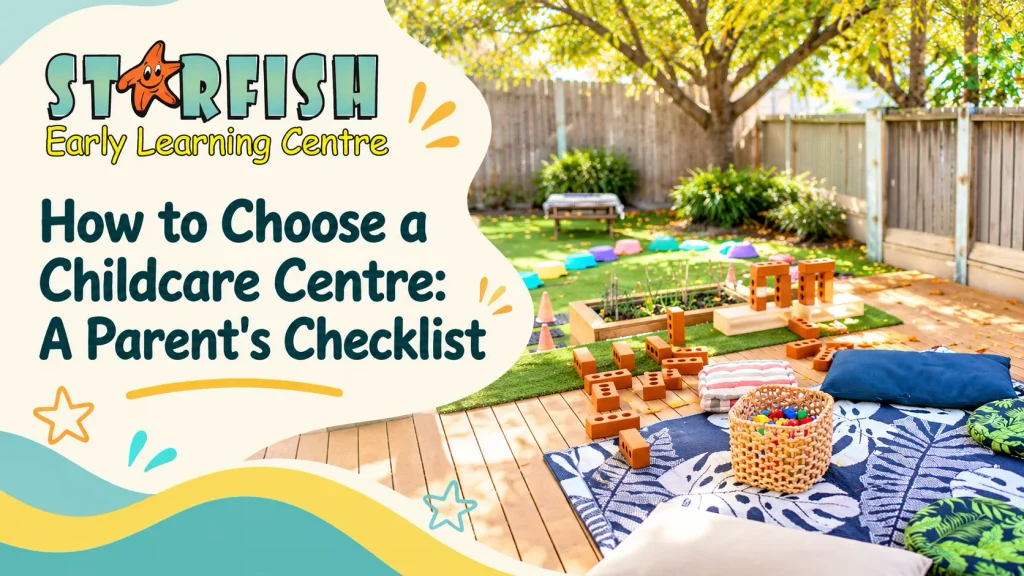
Check for shade, for covered space you can still use in July, and for materials a child can actually change. Sand, water, soil, loose parts. Ask how much of the day is spent outdoors and whether that shifts when it rains.
Starfish designs its buildings and learning spaces around indoor-outdoor flow, with natural and recycled materials used throughout.
This one is quick and it separates centres fast.
Are meals cooked on site by a chef, or delivered? Can families see the menu? What happens when a child refuses lunch three days running?
Starfish chefs cook fresh in each centre’s commercial kitchen on a four-week rotating menu, and every centre is nut and egg aware. Children are never made to eat. If a child keeps refusing something, educators offer a known alternative and tell the family.
A laminated daily timetable is not a curriculum. Ask what the programme is built on and how educators decide what happens next.
You’re listening for the Early Years Learning Framework, observation of individual children, and learning that shows up inside real experiences rather than worksheets. Starfish is Reggio-inspired and EYLF-aligned, and children take part in the Stephanie Alexander Kitchen Garden Program: they plant it, grow it, harvest it, then cook with it.
Ask what costs extra. At Starfish, incursions in physical education, dance, music, animals and Indigenous culture are part of the programme, not add-ons.
Every approved service in Australia is assessed against the National Quality Standard across seven quality areas. Ratings run from Working Towards through Meeting, Exceeding, and Excellent.
You don’t have to take a centre’s word for it. Search any service on the ACECQA national registers and read the rating yourself. Ratings are reassessed periodically, so check the date.
While you’re there, ask about child safety. Starfish is a Child Safe Organisation with anonymous reporting linked from every page of the site. Any centre should be able to tell you plainly how a concern gets raised and who handles it.
The advertised daily fee isn’t what you’ll pay, and it isn’t what you should compare.
Start with the Child Care Subsidy calculator on the Australian Government’s Starting Blocks site, or use the Starfish subsidy calculator to estimate your gap fee. If your child is three or four, check Free Kinder as well, which applies to funded kindergarten programmes inside long day care.
Then ask what’s included. Nappies, wipes, sunscreen, meals and incursions are all in the daily fee at Starfish. At some centres they’re line items, and that gap adds up across a year.
Sometimes you tour two centres and both are good. That’s a nice problem, and there’s no single best childcare centre checklist that will break the tie for you, because the right centre depends on your child and your week.
Choosing a childcare centre usually comes down to three things at that point. Whether the same educators stay with your child through the day. Whether the Centre Director knew your child’s name by the end of the tour. And whether the drive still works on a wet Tuesday in August with a sick baby in the back.
Trust what you noticed in the room. Parents are usually right about this.
Starfish has six privately-owned centres across Melbourne: Blackburn South, Clayton South, Essendon, Nunawading, Reservoir and Springvale. We take children from six weeks to five years, and we’ve been doing this since 2009.
Tours run by appointment with the Centre Director, Monday to Friday between 7am and 6pm. Come during a busy part of the day if you can.
Bring this checklist. Ask us every question on it.
Book a tour or call 1300 168 881 and we’ll match you with your closest centre.