Child Safety in Childcare: How Starfish ELC Builds It Into Every Day
October 22, 2026
The Early Years Learning Framework can sound like something written for educators, not families.
But it matters to parents too.
It shapes what children experience in early childhood education and care. It helps educators plan learning that supports each child’s identity, wellbeing, confidence, communication and connection with others.
At Starfish ELC, the EYLF sits behind many of the small moments families see each day.
A toddler pouring water between cups. A preschool child drawing a map of the garden. A group of children building a bridge from blocks, solving problems and trying again.
These moments may look like play. They are also learning.
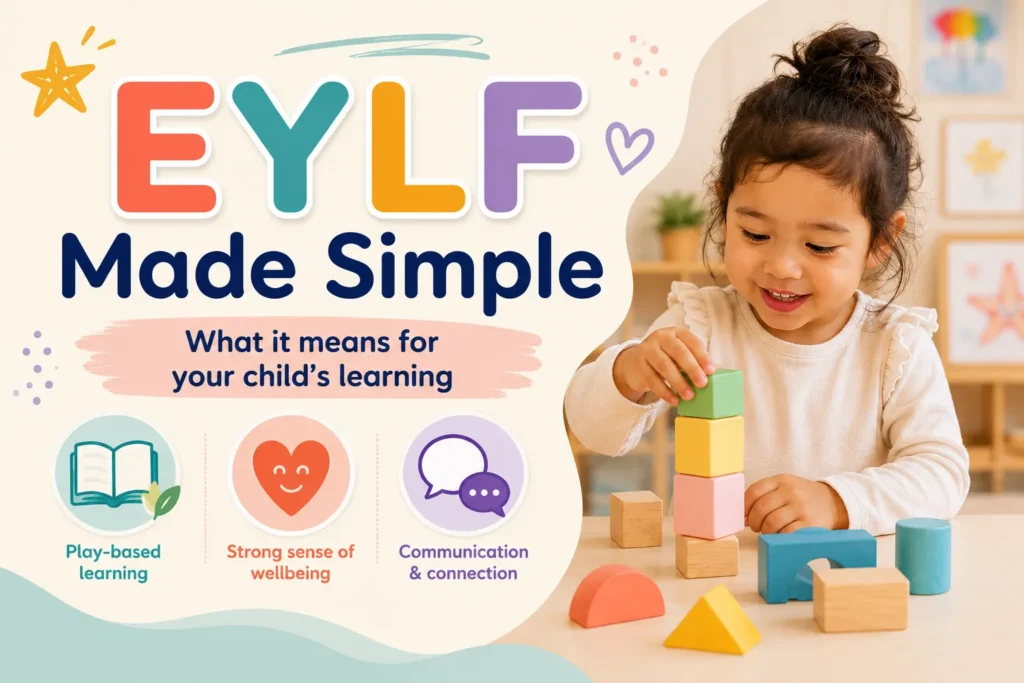
The Early Years Learning Framework, often called the EYLF, is Australia’s national approved learning framework for children from birth to 5 years.
It guides educators as they plan, deliver and reflect on children’s learning. It is used in long day care, early learning centres, preschool and kindergarten settings.
The framework does not give every service a fixed lesson plan. Instead, it gives educators a shared way to think about children, learning, relationships and curriculum.
It asks educators to notice each child’s interests, strengths, culture, family context and stage of development.
That is why early learning should not feel like school pushed down into younger years.
For young children, learning happens through relationships, movement, language, wonder, play and time.
EYLF stands for Early Years Learning Framework.
For families, the simplest way to understand the EYLF is this: it helps educators plan learning that is meaningful for young children.
This includes:
The EYLF reminds educators that children are not empty containers waiting to be filled.
They are capable learners. They arrive with ideas, questions, relationships, culture, feelings and ways of understanding the world.
The Early Years Learning Framework matters because it gives early childhood education a clear purpose.
It helps educators look beyond whether a child can name letters, count blocks or sit still for group time. Those things can be part of learning, but they are not the whole picture.
A strong early learning program also asks:
These are the foundations children carry into school and life.
At Starfish ELC, we see this in everyday moments. A child who once watched from the edge joins the sandpit game. A toddler starts using words to ask for help. A kindergarten child keeps working on a tricky puzzle because an educator sits nearby and says, “Let’s look at it another way.”
That is learning in action.
Play-based learning is a central part of how young children learn.
It does not mean children are left to “just play” while educators stand back. Strong play-based learning is thoughtful, intentional and responsive.
An educator may set up clay, seed pods and magnifying glasses after noticing children collecting leaves outside. They may ask questions, introduce new words, help children compare textures and encourage them to draw what they see.
The children are playing. They are also building language, fine motor skills, focus, early science thinking and confidence.
In a Starfish ELC room, play-based learning might look like:
The learning is real because the child is interested.
The EYLF helps shape the childcare curriculum, but it is not a strict day-by-day script.
A childcare curriculum is the full learning program children experience across the day. It includes planned experiences, spontaneous play, routines, conversations, rest, meals, outdoor time, relationships and transitions.
The EYLF gives educators a framework for making those experiences meaningful.
For example, if a group of children becomes interested in building homes for animals, educators may extend that interest through books, drawing, block construction, outdoor investigation and group discussion.
One child might focus on language. Another might explore measurement. Another might practise cooperation. Another might express care for living things.
The curriculum grows from what children show us.
The EYLF includes five broad learning outcomes.
These outcomes help educators observe, plan and reflect on children’s development. They are not a checklist that every child must complete in the same way or at the same pace.
The five learning outcomes are:
For parents, these outcomes can make early learning easier to understand.
When your child learns to say goodbye with more confidence, that connects to identity and wellbeing.
When they help care for a garden, that connects to their world.
When they try a new material, ask a question or keep going after a mistake, that connects to confident learning.
When they tell a story, sing, draw, gesture or listen, that connects to communication.
Kindergarten learning under the EYLF is active, social and purposeful.
Children are not expected to sit at desks all day or complete worksheets to prove they are learning. They learn through projects, stories, movement, conversation, creative work, outdoor exploration and shared problem-solving.
In a kindergarten room, educators may support children to:
This is not separate from school readiness. It is school readiness, in a way that respects how young children learn best.
The EYLF supports children before school by building confidence, independence, social skills and a love of learning.
A child who can ask for help, listen to a story, try again after frustration, care for their belongings and join group play is building important foundations for school.
So is a child who can wonder.
Why does the water move that way? What happens if we make the tower wider? How can we help our friend feel better?
These questions matter. They show that children are thinking, connecting and making meaning.
At Starfish ELC, we want children to feel capable before they step into school. Not rushed. Not pressured. Capable.
Educators use the EYLF through observation, planning, action and reflection.
They notice what children are doing. They listen to their ideas. They plan experiences that build on interests and needs. Then they reflect on what happened and where the learning could go next.
This cycle helps learning stay alive.
A simple interest in worms after rain might lead to a garden investigation. Children may draw worms, read books about soil, talk about compost, compare lengths, learn new words and care for a garden bed.
One moment opens many doors.
This is why early childhood education is skilled work. Educators are not only supervising children. They are reading the room, noticing learning, guiding relationships and making decisions all day.
Families may not always see the EYLF named on a wall or printed across a daily update.
They will see it in the way learning feels.
You might see children moving between indoor and outdoor spaces. You may see educators sitting at a child’s level, asking thoughtful questions or helping two children find the words to solve a problem.
There may be blocks, loose parts, gardens, water play, books, music, clay, dramatic play and quiet spaces. Each part can support learning when educators use it with care and intention.
At Starfish ELC, our play-based approach is shaped by children’s curiosity, strong relationships and the belief that children learn best when they feel they belong.
Families do not need to recreate a childcare curriculum at home.
Simple everyday moments are enough.
You can support your child’s learning by:
A question like “What do you think will happen?” can open rich learning.
So can “Tell me about your drawing,” or “How did you solve that?”
Children do not need every moment turned into a lesson. They need time, trust and interested adults.
If you are comparing early learning centres, the EYLF can help you ask better questions.
You might ask:
The answers should feel clear and practical.
A strong centre, like Starfish ELC, should be able to explain how children learn there, not just what children do there.
The Early Years Learning Framework, or EYLF, is Australia’s national learning framework for children from birth to 5 years. It helps educators plan learning that supports children’s identity, wellbeing, confidence, communication and connection with others.
No. The EYLF supports children from birth to 5 years, so it applies across nursery, toddler, preschool and kindergarten settings. Educators use it in age-appropriate ways, from babies exploring sound and movement to kindergarten children building early literacy, numeracy and social skills.
The EYLF recognises play as a powerful way for young children to learn. Through play, children build language, social skills, problem-solving, confidence and curiosity. Educators guide this learning by noticing children’s interests, asking questions and planning experiences that extend their thinking.
The EYLF includes five learning outcomes. Children have a strong sense of identity. Children are connected with and contribute to their world. Children have a strong sense of wellbeing. Children are confident and involved learners. Children are effective communicators.
You may see the EYLF in everyday moments, such as block building, pretend play, drawing, gardening, stories, outdoor play and group conversations. These moments help children practise communication, independence, creativity, cooperation and problem-solving.
At Starfish ELC, the EYLF helps shape how educators observe, plan and respond to children’s learning. It supports a play-based approach where children feel safe, known and encouraged to explore, ask questions, build relationships and develop confidence before school.
Yes. Families can support EYLF learning through simple everyday moments. Reading together, talking during routines, spending time outside, asking open questions and giving children time to try things for themselves all help build confidence, language and independence.
The Early Years Learning Framework gives families a helpful way to understand quality early learning.
But the best way to understand a centre is to visit.
Book a tour at your nearest Starfish Early Learning Centre to see the rooms, meet the team and ask how our educators support play-based learning, kindergarten learning and everyday moments of growth.
You can explore your nearest Starfish centre here:
You will see that learning does not only happen during group time or planned activities.
It happens when children feel safe enough to explore, known enough to try, and connected enough to wonder.